
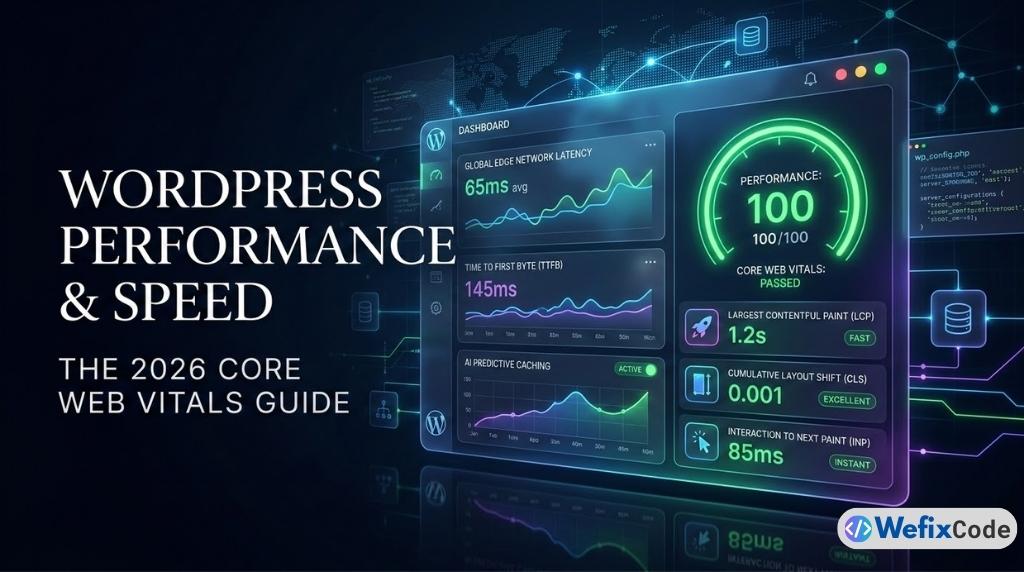
1. The 2026 Speed Benchmarks: What “Fast” Looks Like Today
Gone are the days when a 3-second load time was acceptable. In 2026, the benchmarks have tightened significantly:
- Largest Contentful Paint (LCP): Under 1.8 seconds.
- Time to First Byte (TTFB): Under 200ms (Global edge-cached) or 500ms (Origin).
- Interaction to Next Paint (INP): Under 150ms.
- Cumulative Layout Shift (CLS): Zero (0.0).
Why These Metrics Matter
User behavior has evolved. Modern users, fueled by 6G speeds and high-performance mobile devices, exhibit a “micro-moment” attention span. A delay of even 100ms in interaction feedback can lead to a 7% drop in conversion rates.
2. Infrastructure: The Foundation of Performance
You cannot build a Ferrari on a tractor chassis. Your hosting environment is the single most important factor in your speed strategy.
The Shift to Edge Computing
In 2026, standard “Shared Hosting” is effectively obsolete for professional sites. Senior developers are now moving toward Edge-Integrated Hosting. This means your site isn’t just “hosted” in one location; it is distributed across a global network of servers (like Cloudflare Supercloud or Vercel for WordPress).
Critical Infrastructure Checklist:
- NVMe Gen5 Storage: Standard SSDs are no longer sufficient for high-concurrency database queries.
- Object Caching (Redis/Memcached): Essential for reducing database load by storing frequent query results in RAM.
- HTTP/3 (QUIC) Protocol: This is now the standard for reducing latency in the handshake process between the browser and server.
3. Modern Image Optimization: Beyond WebP
While WebP was the hero of 2022, AVIF (AV1 Image File Format) is the king of 2026.
Why AVIF?
AVIF offers 30% better compression than WebP without sacrificing visual fidelity. For a media-heavy WordPress site, this can mean the difference between a 2MB page and a 600KB page.
AI-Driven Responsive Images
Modern performance specialists are using AI to generate “Context-Aware Crops.” Instead of just resizing a photo, AI analyzes the focal point of an image and ensures that the mobile version of the site serves a crop that highlights the subject while minimizing unnecessary pixel data.
4. The Role of AI in Predictive Loading
One of the most exciting trends in 2026 is Predictive Prefetching. By using lightweight AI models (like Guess.js integrated with WordPress), your site can analyze a user’s mouse movement and past behavior to predict which page they will click next.
How it works:
- As a user hovers over a “Buy Now” button, the browser silently begins fetching the checkout page resources in the background.
- When the user clicks, the page appears to load instantly (0ms perceived latency).
5. Theme Architecture and the “Gutenberg-First” Approach
Professional UI/UX in 2026 demands a shift away from heavy, “all-in-one” page builders. Senior developers are now opting for:
- Block Themes: Utilizing Full Site Editing (FSE) to eliminate the need for heavy CSS frameworks.
- Clean Code Principles: Modern themes like Astra, GeneratePress, or custom-coded block-based solutions are the standard.
Avoiding “DOM Bloat”
A common mistake is having too many nested <div> elements. AI-driven design tools now help developers “flatten” the DOM, which reduces the work the browser’s rendering engine has to perform, directly improving the INP (Interaction to Next Paint) score.
6. Advanced Caching Strategies
Caching is no longer just about “Static HTML.” In 2026, we utilize Layered Caching Architecture:
| Cache Layer | Technology | Function |
| Edge Cache | Cloudflare / Fastly | Serves the entire page from the nearest geographic server. |
| Object Cache | Redis | Speeds up the WordPress database and PHP execution. |
| Browser Cache | Cache-Control Headers | Instructs the user’s phone to store assets locally. |
| Fragment Cache | Custom PHP | Caches specific parts of a page (like a complex menu) while keeping others dynamic. |
7. Eliminating Third-Party Script Latency
The “Silent Killer” of WordPress speed is often third-party scripts (Google Analytics, Facebook Pixels, Hotjar).
The Solution: Script Offloading
In 2026, we use Web Workers (via tools like Partytown) to run these scripts in a background thread. This prevents them from “blocking” the main thread, ensuring the user can interact with the site while the analytics are being processed in the background.
8. Database Maintenance for Senior Developers
A bloated wp_options table can kill a site’s performance. Senior developers should perform:
- Autoload Audit: Ensure only essential data is set to “autoload” on every page.
- Table Optimization: Regular cleaning of transients, revisions, and orphaned metadata.
- Database Partitioning: For WooCommerce sites with over 50,000 orders, partitioning the database is essential for maintaining query speed.
9. Mobile-First Performance in a 6G World
With the rollout of 6G, users expect high-definition video and interactive 3D elements (AR/VR) to load instantly.
- Video Performance: Use HLS (HTTP Live Streaming) instead of raw MP4 files to allow for adaptive bitrate streaming based on the user’s connection.
- Critical CSS: In 2026, we automate the generation of “Above the Fold” CSS to ensure the visual part of the site renders in under 500ms.
10. Conclusion: The Performance Mindset
Achieving a 100/100 PageSpeed score in 2026 isn’t about one single plugin; it’s about a holistic approach to design, infrastructure, and code quality. By prioritizing modern standards like AVIF, Edge Caching, and AI Predictive Loading, you aren’t just building a website—you’re building a competitive business asset.
Performance Audit Checklist for 2026
- [ ] Is your hosting provider utilizing NVMe Gen5 and HTTP/3?
- [ ] Have you migrated all images to AVIF?
- [ ] Is your TTFB consistently under 200ms at the Edge?
- [ ] Are you using Web Workers to offload tracking scripts?
- [ ] Does your mobile version achieve an LCP of < 1.8s?